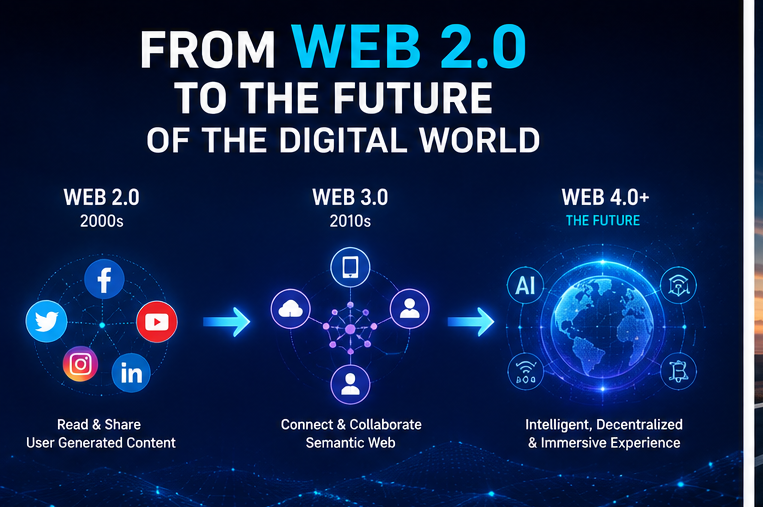
The internet has transformed from a collection of simple websites into a powerful digital ecosystem that influences almost every part of modern life. People use the web to communicate, work, study, shop, manage businesses, watch entertainment, access financial services, and connect with communities around the world.
One of the most important stages in this evolution was Web 2.0, which turned internet users from passive readers into active participants. Social networks, blogs, video-sharing platforms, online communities, and cloud-based applications created an internet centered around interaction and user-generated content.
Today, another transformation is underway. Artificial intelligence, blockchain, immersive technologies, the Internet of Things, decentralized systems, and advanced connectivity are shaping the future of the digital world.
Understanding the journey from Web 2.0 to emerging digital technologies helps explain where the internet has been—and where it may go next.
What Is Web 2.0?
Web 2.0 describes the stage of internet development in which websites became increasingly interactive, social, and driven by user-generated content.
Earlier websites were often relatively static. A company or publisher created information, and visitors mainly consumed it.
Web 2.0 changed this relationship.
Users could create profiles, upload photos, publish videos, write comments, share opinions, collaborate on documents, and build online communities.
The web became a platform for participation rather than simply a digital library.
Major Characteristics of Web 2.0
Several features helped define the Web 2.0 era.
User-Generated Content
Perhaps the biggest change was allowing ordinary users to become content creators.
People could publish blogs, upload videos, post photographs, review products, participate in forums, and share their knowledge with large audiences.
This significantly reduced the barriers to publishing information online.
Social Networking
Social networking became one of the defining features of Web 2.0.
Instead of visiting websites only to obtain information, users began creating online identities and interacting with friends, families, businesses, celebrities, and communities.
Digital communication became faster and increasingly global.
Interactive Websites
Websites became more responsive and dynamic.
Users could interact with web applications, customize their experiences, receive personalized recommendations, and see content updated without constantly loading completely new pages.
Cloud-Based Services
Cloud technology allowed software and information to become accessible through the internet.
Instead of storing everything locally on one computer, users could access documents, photographs, applications, and other information from multiple devices.
Cloud computing eventually became an essential part of modern digital infrastructure.
How Web 2.0 Changed Everyday Life
Web 2.0 did more than improve websites. It transformed social and economic behavior.
People started maintaining relationships through social networks. Businesses could communicate directly with customers. Independent creators gained access to global audiences.
Online reviews changed purchasing decisions, while digital marketplaces transformed retail.
Education also changed as students gained access to online videos, collaborative tools, learning platforms, and digital resources.
The modern creator economy, influencer marketing, remote collaboration, and many forms of digital entrepreneurship developed largely within the Web 2.0 environment.
Limitations of Web 2.0
Despite its enormous benefits, Web 2.0 introduced significant challenges.
A relatively small number of large platforms became responsible for storing and managing enormous amounts of user information.
This raised questions about:
- Data privacy
- Digital surveillance
- Cybersecurity
- Misinformation
- Online manipulation
- Platform control
- Ownership of digital content
- Algorithmic influence
Many online services are free to use because their business models depend partly on advertising and user data.
As awareness of these issues has increased, developers and researchers have explored alternative approaches to digital ownership, privacy, and control.
The Idea of Web 3.0
The term Web 3.0, or Web3 in some contexts, is used in different ways.
Broadly, it describes ideas about the next generation of the internet. Depending on the context, this may include decentralized networks, blockchain-based services, digital ownership, intelligent systems, and more personalized online experiences.
It is important to recognize that Web 3.0 is not one finished technology replacing Web 2.0 overnight.
Instead, the digital world is evolving gradually, and technologies associated with different generations of the web are likely to coexist.
Blockchain and Decentralization
Blockchain is frequently discussed as part of the future of the internet.
Traditional online platforms often depend on centralized organizations that manage databases and control access.
Blockchain technology provides a distributed method of recording information across a network.
Supporters of decentralized systems believe this approach could provide users with greater control over digital assets and certain online interactions.
Potential blockchain applications include digital identity, financial services, supply-chain tracking, ownership records, and decentralized applications.
However, blockchain is not automatically the best solution for every problem. Scalability, usability, regulation, security, and energy consumption can all be important considerations depending on the technology being used.
Artificial Intelligence and the Future Web
While decentralization receives significant attention, artificial intelligence may have an even broader influence on everyday internet experiences.
AI is already changing how people search for information, create content, communicate with software, analyze data, and automate tasks.
Generative AI systems can create:
- Text
- Images
- Computer code
- Audio
- Video
- Summaries
- Business reports
- Digital designs
Future websites and applications may increasingly include intelligent assistants capable of understanding user requests through natural language.
Instead of navigating multiple menus, users may simply describe what they want the system to accomplish.
The Rise of AI Assistants
Traditional search engines generally provide users with links to relevant information.
AI assistants can take a different approach by analyzing a question and generating a direct response.
As these technologies improve, digital assistants may become increasingly capable of helping people research topics, organize information, create documents, analyze datasets, learn new skills, and manage routine digital activities.
This could significantly change how people interact with the web.
The internet may become less about manually navigating individual pages and more about communicating with intelligent systems that help users find and process information.
The Internet of Things
The Internet of Things (IoT) is another technology expanding the boundaries of the digital world.
IoT connects physical devices to digital networks.
Examples include:
- Smart home appliances
- Fitness trackers
- Security cameras
- Industrial sensors
- Connected vehicles
- Smart energy systems
In the future, the distinction between being “online” and “offline” may become increasingly difficult to define.
Homes, vehicles, factories, cities, and personal devices could continuously exchange information through connected networks.
The Future of Smart Homes
Modern smart homes already allow people to control lighting, security, entertainment, and temperature through connected devices.
Future systems could become more automated.
Artificial intelligence may learn household routines and adjust devices according to user preferences.
For example, an intelligent home could optimize energy consumption based on occupancy patterns or adjust environmental settings automatically.
The challenge will be ensuring that increasingly connected homes remain private and secure.
Virtual Reality and Augmented Reality
The web has traditionally been experienced through screens.
Virtual reality (VR) and augmented reality (AR) could make digital experiences more immersive.
VR places users inside computer-generated environments, while AR adds digital information to the physical world.
These technologies could influence:
- Gaming
- Education
- Remote work
- Healthcare
- Online shopping
- Training
- Architecture
- Entertainment
A student could explore a historical environment virtually, while a customer could preview furniture inside their home before purchasing it.
The future internet may therefore become more spatial and interactive.
Digital Identity
Today, users often create separate accounts for different websites and applications.
Future digital identity systems could potentially provide individuals with more portable ways to verify selected information across services.
A secure digital identity could help users prove qualifications, access services, or verify certain credentials without repeatedly creating separate records.
However, digital identity also creates significant privacy and security questions.
Any system handling identity information needs strong protection, limited data collection, and appropriate user control.
Digital Ownership
Web 2.0 made it easy to create and distribute digital content, but questions about ownership remain complicated.
A person may build an audience on a social platform, for example, while the platform ultimately controls important aspects of the account and service.
Emerging technologies are exploring new ways of representing ownership of digital assets.
Blockchain-based systems are one example, although technical ownership does not automatically resolve copyright, legal, or consumer-protection questions.
The future of digital ownership will likely depend on both technology and regulation.
Cybersecurity in the Future Digital World
As digital systems become more powerful, cybersecurity becomes even more important.
The future internet may contain billions of connected devices, AI-powered applications, cloud services, digital financial systems, and intelligent infrastructure.
Each connected system can potentially create new security risks.
Future cybersecurity strategies will need to protect:
- Personal information
- Cloud infrastructure
- AI systems
- Connected devices
- Financial transactions
- Digital identities
- Business networks
- Critical infrastructure
AI itself will play an important role in cybersecurity.
Security systems can use machine learning to analyze activity and identify suspicious behavior. At the same time, attackers may also use AI to create more sophisticated threats.
Cloud and Edge Computing
Cloud computing became an essential part of the Web 2.0 era, and it will remain important in the future.
However, another approach known as edge computing is becoming increasingly valuable.
Edge computing processes some information closer to where it is generated instead of sending everything to distant cloud data centers.
This can reduce delays and support applications requiring rapid responses.
Autonomous systems, smart factories, connected vehicles, and IoT devices can benefit from combining cloud and edge computing.
Faster Connectivity and Future Networks
Advanced digital experiences require powerful network infrastructure.
5G has improved wireless speed, capacity, and latency in supported environments. Future generations of networking technology are expected to continue improving connectivity.
Faster networks can support more connected devices and advanced applications.
Combined with cloud computing, AI, IoT, and edge computing, advanced connectivity can become the foundation of increasingly intelligent digital environments.
The Evolution of E-Commerce
Web 2.0 helped transform online shopping into a global industry.
Future e-commerce experiences may become considerably more personalized.
AI can analyze shopping behavior to improve product discovery and recommendations. Augmented reality can allow customers to visualize products before purchasing them.
Conversational AI assistants could also help customers compare products and navigate online stores.
Digital commerce may therefore become more interactive and personalized.
Education in the Future Digital World
Education has already changed significantly because of the internet.
Students can access online courses, video lessons, digital libraries, virtual classrooms, and interactive learning platforms.
Future education could combine AI tutors, personalized learning, immersive simulations, and traditional teaching.
AI systems could help identify areas where students need additional practice, while VR environments could provide interactive experiences that are difficult to recreate in traditional classrooms.
Teachers would remain essential for guidance, critical thinking, communication, and mentorship.
The Future of Digital Work
Web 2.0 helped create the infrastructure required for remote work and online collaboration.
The next stage could make distributed work even more sophisticated.
Employees may increasingly use:
- AI assistants
- Virtual collaboration environments
- Cloud applications
- Automated workflows
- Real-time translation
- Intelligent scheduling systems
- Advanced communication tools
Routine digital activities may become increasingly automated, allowing workers to focus on tasks requiring creativity, judgment, strategy, and human interaction.
Privacy in the Next Generation of the Internet
Privacy is likely to become one of the defining issues of the future digital world.
Modern digital platforms can collect information about searches, purchases, locations, interests, interactions, and online behavior.
Future systems may generate even more information through connected devices and intelligent services.
Organizations will therefore need strong data-protection practices.
Users are also likely to demand greater transparency about what information is collected and how it is used.
Building trust could become just as important as creating innovative features.
Web 2.0 vs. the Future Digital World
Web 2.0 focuses heavily on participation, social interaction, centralized platforms, cloud services, and user-generated content.
The future digital world may expand these ideas through artificial intelligence, decentralization, immersive experiences, intelligent devices, and greater automation.
However, the transition will not happen instantly.
Many successful Web 2.0 technologies will continue to exist while newer systems are gradually integrated into everyday digital experiences.
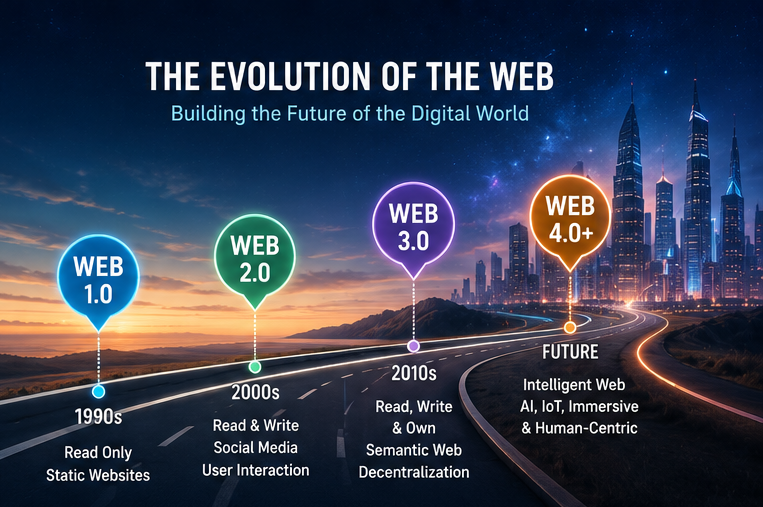
The future web is therefore better understood as an evolution rather than a complete replacement.
Challenges Facing the Future Internet
Technological advancement also creates difficult challenges.
Misinformation
AI-generated content can make it easier to create realistic but inaccurate information.
Digital literacy and reliable verification methods will become increasingly important.
Cybercrime
More digital services can create additional opportunities for cyberattacks.
Security needs to develop alongside innovation.
Digital Inequality
Not everyone has equal access to high-speed internet, modern devices, or advanced digital skills.
If these differences are not addressed, technological progress could increase existing inequalities.
Regulation
Governments face the difficult task of protecting citizens without unnecessarily restricting useful innovation.
AI, privacy, digital assets, online safety, and cybersecurity are likely to remain major areas of regulatory discussion.
Skills Needed for the Future Digital Economy
As the internet continues to evolve, digital skills will become increasingly important.
Useful skills may include:
- Artificial intelligence literacy
- Data analysis
- Cybersecurity
- Programming
- Cloud computing
- Digital marketing
- Critical thinking
- Online communication
- Content creation
- Information verification
People will not necessarily need to become software engineers, but understanding how digital technologies work can help them adapt to changing careers and industries.
Frequently Asked Questions
What is Web 2.0?
Web 2.0 describes the interactive and social stage of the internet characterized by user-generated content, social networks, online communities, and dynamic web applications.
What comes after Web 2.0?
There is no single universally agreed replacement. Web3, artificial intelligence, decentralized technologies, IoT, immersive computing, and intelligent digital services are all contributing to the internet’s continued evolution.
What is the difference between Web 2.0 and Web3?
Web 2.0 commonly relies on centralized platforms that manage user accounts and data. Web3 generally refers to approaches that use blockchain and decentralized technologies to provide different models of digital ownership and interaction.
Will artificial intelligence change the internet?
AI is already changing online search, content creation, software development, customer service, analytics, and digital communication. Its influence is expected to expand as AI becomes integrated into more online services.
Is Web 2.0 going to disappear?
Probably not. Many Web 2.0 technologies and services are likely to remain while newer technologies are gradually integrated into existing platforms.
Conclusion
The journey from Web 2.0 to the future of the digital world represents one of the most significant technological transformations of modern society.
Web 2.0 transformed users from passive consumers into active creators and participants. Social networking, cloud computing, online communities, digital commerce, and user-generated content changed how billions of people experience the internet.
The next stage is likely to be shaped by artificial intelligence, connected devices, immersive technologies, advanced computing, stronger digital identities, and experiments with decentralized systems.
However, technological progress also brings responsibility. Privacy, cybersecurity, misinformation, accessibility, and ethical use of AI must remain central to future development.
The future internet will not simply be faster. It is likely to become more intelligent, interactive, connected, and deeply integrated into everyday life.